



Walking and Standing: How Physics Keeps You Balanced
Mon Nov 03 2025
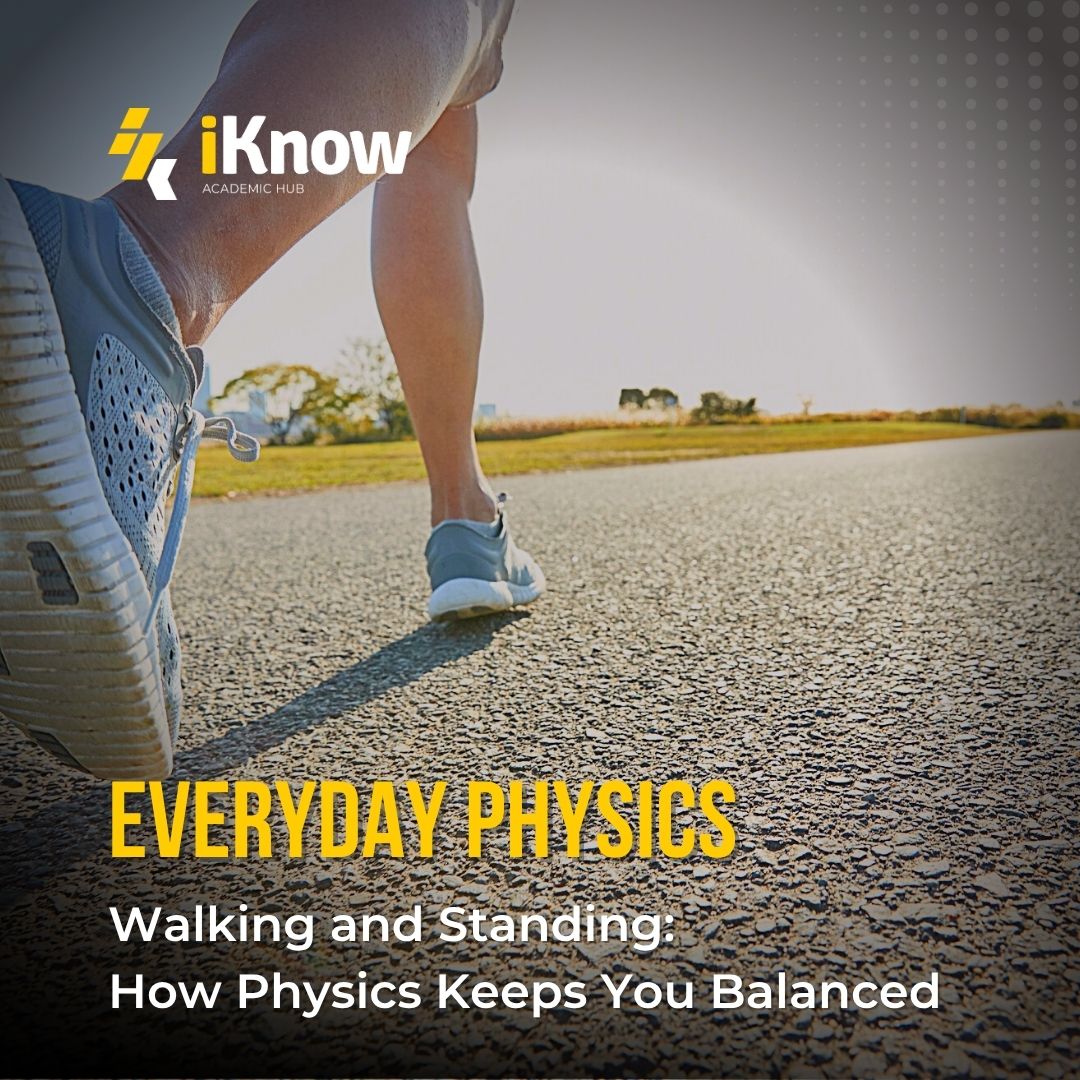
Walking and Standing: How Physics Keeps You Balanced
Have you ever thought about how you stay upright while walking or standing still? What seems like a simple act—taking a step—is actually a dance of forces, friction, and motion governed by everyday physics. At iKnow Academic Hub, we believe that learning Physics isn’t just about solving equations—it’s about seeing the science that keeps you moving.
The Inertia That Keeps You Going

According to Newton’s First Law of Motion, an object at rest stays at rest, and an object in motion stays in motion unless acted upon by an external force. This principle, called inertia, explains why once you start walking, your body naturally wants to keep moving forward.
But why don’t you just slide endlessly? That’s where friction comes in. The tiny ridges and roughness between your shoes and the ground resist your motion, allowing you to push off and control your steps .
Without friction, every step would be like walking on ice—you’d have motion but no control. In fact, scientists have found that even subtle differences in shoe material can change how stable we feel when walking .
Newton’s Third Law in Every Step
When your foot pushes backward on the ground, the ground pushes forward with an equal and opposite reaction. This is Newton’s Third Law in action—“For every action, there is an equal and opposite reaction.”
This forward push from the ground propels you ahead. Without it, you couldn’t walk at all. Even standing still involves this balance of forces: your body weight pushes down, and the ground pushes up with an equal normal force. The result? You stay upright instead of sinking into the floor.
At iKnow Academic Hub, we help students connect these textbook ideas with real life—because understanding Newton’s Laws means understanding how you move through the world.
Balance and the Center of Gravity

Why do tightrope walkers spread their arms or carry a long pole? The secret lies in the center of gravity—the point where your body’s weight is evenly distributed. The lower and more stable your center of gravity, the easier it is to balance.
When you stand still, your center of gravity must stay above your base of support (your feet). If it moves too far outside that area, you lose balance and fall. Even walking is a series of controlled falls—each step catches you before you topple over.
Every athlete, dancer, or even student carrying a backpack unconsciously adjusts their balance to keep their center of gravity aligned. It’s everyday physics in motion!
The Physics of Everyday Balance
Let’s break it down into simple terms:
-
Inertia keeps your motion going when you walk.
-
Friction lets you push off the ground and control your steps.
-
Action and reaction (Newton’s Third Law) move you forward.
-
Center of gravity helps you stay balanced whether standing or walking.
Together, these laws explain something we do thousands of times a day—without even thinking.
Learning Motion with Purpose
At iKnow Academic Hub, we make sure students don’t just memorize Newton’s Laws—they experience them. Through real-world examples, hands-on review sessions, and problem-solving techniques, we help learners see that every step, push, and balance they perform is a lesson in motion.
Physics isn’t far away—it’s beneath your feet.
From your first step in the morning to your last stretch before bed, the laws of motion are always at work. The next time you walk across the classroom or run for the bus, remember: you’re applying Newton’s Laws without even noticing.
At iKnow Academic Hub, we believe smarter preparation builds stronger futures. Join our programs today and make every lesson—like every step—a step toward success.
References:
-
Giandolini, M. et al. “Impact reduction during running: efficiency of simple acute interventions in recreational runners.” European Journal of Applied Physiology (2013).
-
Willems, C., et al. “Influence of shoe–surface interaction on balance and stability.” Footwear Science (2016).
Read more blogs
See all blogs
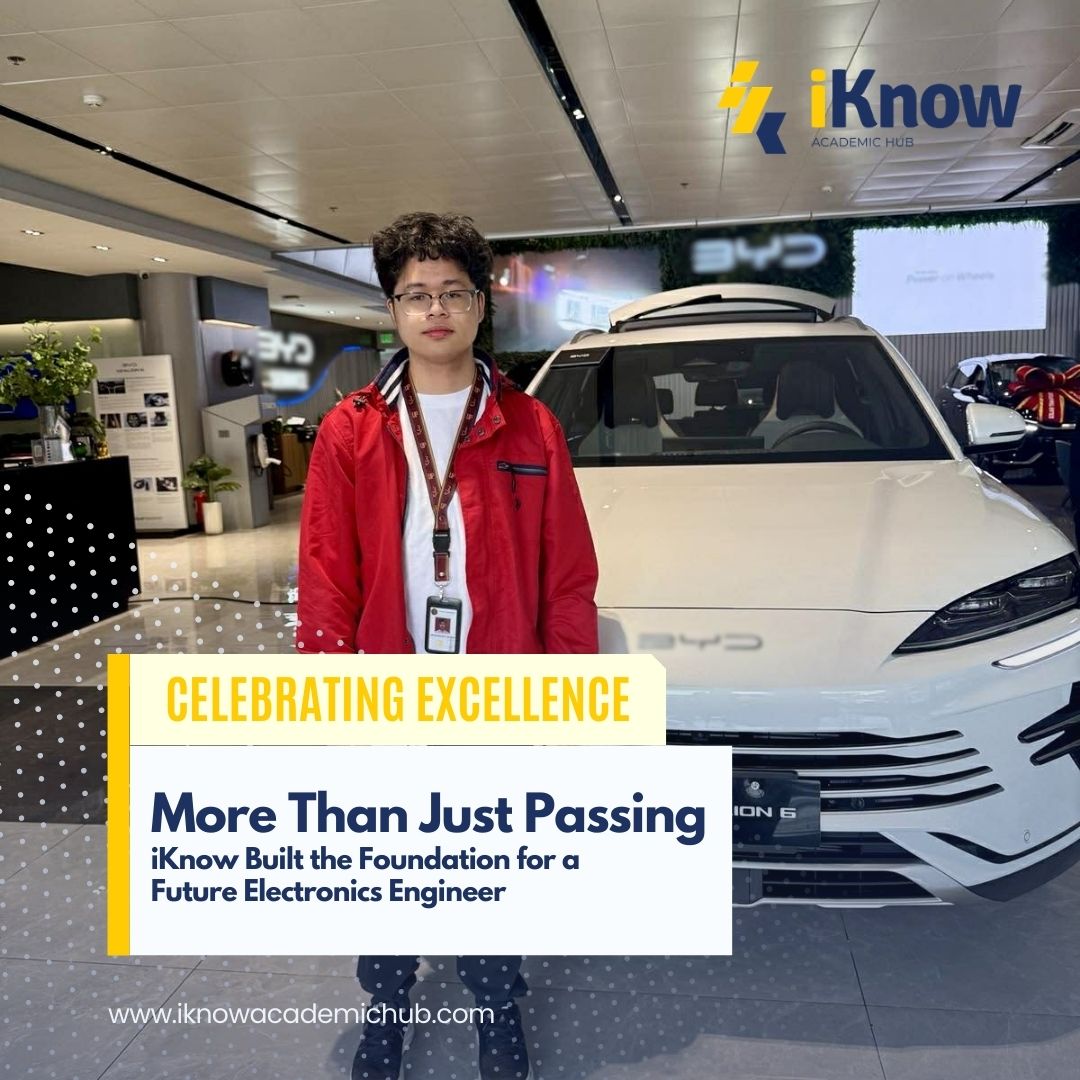
More Than Just Passing: iKnow Built the Foundation for a Future Electronics Engineer
Mon Feb 23 2026Success at iKnow Academic Hub is never just about passing an entrance exam. It is about building a foundation strong enough to carry students through the years ahead. Lex RJ Roland Biteng began his journey with iKnow Academic Hub in Grade 11. Like many driven students, he had one goal: to pass the Big 4 college entrance exams. What he gained, however, was far more than test strategies. Today, Lex RJ is in his second year at the University of the Philippines Diliman, taking up BS Electronics Engineering. His consistent performance in Math, Physics, and core engineering subjects reflects something deeper than exam success. It reflects preparation that lasts. This is a story of long-term academic impact. From Grade 11 Review to Big 4 Passer Starting early in Grade 11 gave Lex RJ time to strengthen his fundamentals before senior year pressure intensified. At iKnow Academic Hub, preparation was structured, focused, and strategic. The results speak for themselves: ACET Passer – BS Management Engineering DCAT Passer – BS Civil Engineering UPCAT Passer – BS Electronics Engineering USTET Passer – BS Civil Engineering Passing all four major entrance exams is already an achievement. But what makes this story powerful is what happened after. In his testimonial, Lex shared: “iKnow truly played a pivotal role in my success in the UPCAT, ACET, USTET, and DCAT. The guidance provided invaluable techniques for tackling various math problems effectively. Moreover, I gained a comprehensive understanding of common patterns in English and essential Science topics.” For many students, entrance exam success is the finish line. For Lex, it was just the beginning. Building a Strong Math and Physics Foundation One of the core strengths of iKnow Academic Hub is strengthening fundamentals in Math and Science. This foundation became critical when Lex RJ entered UP Diliman’s Electronics Engineering program. Engineering is not just about formulas. It requires: Deep conceptual understanding Strong problem solving skills Logical reasoning Consistent study discipline In his first semester at UP Diliman, Lex RJ took foundational subjects such as: EEE 111 EEE 113 Math 21 Physics 71 In his second semester: EEE 121 EEE 123 Math 22 Physics 72 These subjects are known for their rigor. They demand the same analytical skills tested in CETs, but at a higher level of difficulty. The transition from CET-style problem solving to university engineering rigor was smoother because the habits were already built during his review at iKnow Academic Hub. Consistent Academic Performance at UP Diliman Lex’s academic performance in AY 2024–2025 reflects not just consistency, but excellence. As a consistent college scholar at UP Diliman, he continues to meet the academic standards required in one of the country’s most competitive engineering programs. Key highlights include: Strong standing in core EEE subjects such as EEE 111, 113, 121, and 123 Solid performance in Math 21 and Math 22 Consistent results in Physics 71 and Physics 72 Every unit completed successfully with no failures Becoming a college scholar in UP Diliman is not automatic. It requires discipline, strong analytical ability, and sustained effort throughout the semester. For parents, this is deeply reassuring. Passing an entrance exam is an important milestone. But maintaining scholar-level performance in a rigorous Electronics Engineering program is the real measure of academic strength. This is where the long-term preparation from iKnow Academic Hub shows its true value. The habits built during Grade 11 did not end with the UPCAT. They carried forward into university life, helping Lex RJ not just enter UP Diliman, but thrive in it. At iKnow Academic Hub, success is not defined by a single test result. It is defined by sustained excellence. From Exam Techniques to Engineering Discipline At iKnow Academic Hub, students are not taught to memorize. They are trained to think. Lex RJ mentioned that instead of focusing on long and complex formulas, he learned smarter techniques. This shift matters in engineering, where: Concepts build on previous lessons Weak foundations quickly become obstacles Time management is crucial The discipline developed during his review year carried over into university life. For students, this means confidence. For parents, this means assurance. For partner schools, this demonstrates measurable academic impact. A Family Victory, Not Just a Student Achievement When Lex RJ passed the UPCAT, his mother who is a lawyer said: “Para akong nakapasa ulit ng bar exam.” That statement captures something powerful. Entrance exams are not just individual milestones. They are family victories. Behind every passer is: A parent who sacrificed A student who stayed consistent A support system that believed At iKnow Academic Hub, we believe families win together. Lex’s journey from Grade 11 reviewee to second-year UP Diliman Electronics Engineering student is proof that smarter preparation builds stronger futures. What This Means for Students and Parents If you are a Grade 11 or Grade 12 student preparing for entrance exams, remember that preparation is not just for the test. It is for the years that follow. If you are a parent, know that the right review center does more than help your child pass. It builds habits, discipline, and academic strength that carry into college. Stories like Lex RJ’s demonstrate measurable outcomes that go beyond marketing claims. They show long-term academic sustainability. Lex RJ’s story reminds us that success is not measured by one exam result. His journey from iKnow Academic Hub reviewee to consistent UP Diliman Electronics Engineering student shows the power of strong foundations, disciplined preparation, and family support. When his mother said, “Para akong nakapasa ulit ng bar exam,” it was not just about the UPCAT. It was about years of preparation finally bearing fruit. At iKnow Academic Hub, we believe smarter preparation builds stronger futures. Join our programs today and give your child the foundation not just to pass, but to thrive.
Read more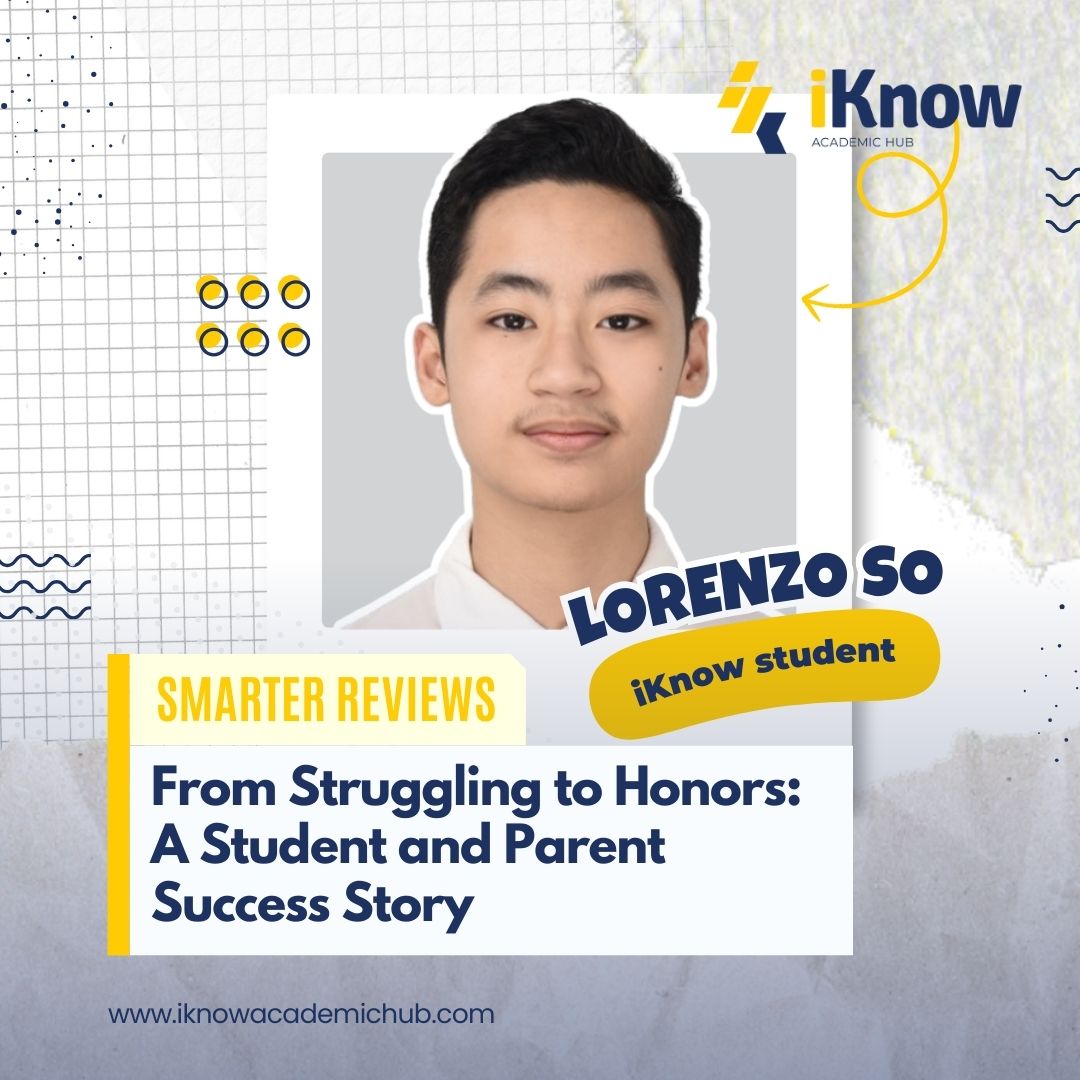
From Struggling in Chemistry to Second Honors: A Student and Parent Success Story
Mon Feb 16 2026Every success story begins with a struggle. For many Filipino students, Chemistry, Math, and Physics can feel overwhelming, especially in the STEM track. At iKnow Academic Hub, we believe that challenges are not roadblocks but turning points. This student and parent success story shows how the right guidance, smarter study methods, and consistent communication can transform academic performance and confidence. Parents often trust real stories more than promises. This is why we are sharing Lorenzo’s journey, from struggling in Chemistry to achieving Second Honors, and eventually becoming a BS Biology major in Medical Biology passer at De La Salle University. A Student’s Journey: From Confusion to Confidence Struggling in Chemistry Like many STEM students, Lorenzo faced difficulty in Chemistry. Complex formulas, problem solving techniques, and exam pressure made studying overwhelming. This is a common experience among high school students preparing for college entrance tests. But instead of giving up, he sought support through iKnow Academic Hub. Smarter Study Methods That Work What made the difference? At iKnow Academic Hub, lessons are delivered clearly and effectively. Instead of memorizing long and complicated formulas, students are taught: Simpler and smarter techniques Concept based understanding Practical shortcuts for problem solving Strategies applicable to different question types According to Lorenzo: “Instead of focusing on memorizing long and complex formulas, the teachers emphasized simpler and smarter techniques that were easier to remember and applicable to different types of problems.” This approach strengthened his understanding of key concepts. More importantly, it boosted his confidence during exams. Confidence changes everything. When students understand the “why” behind the solution, they perform better not just in quizzes, but in major exams and entrance tests. Preparing for College Entrance Tests with Confidence Another key part of this student success story is college entrance test preparation. Lorenzo shared that iKnow greatly helped him throughout high school, especially in preparing for CETs. The review materials were: Easy to understand Well structured Focused on essential topics Designed specifically for entrance exams The iKnow website also played a big role. Its clean and user friendly design allowed him to access: Mock college entrance exams Educational videos Practical academic tips These resources helped him prepare smarter, not just harder. The result? He became a BS Biology major in Medical Biology passer at De La Salle University. For students aiming for top universities, this proves that the right preparation builds real results. A Parent’s Perspective: Reassurance Through Communication Academic improvement is powerful. But for parents, something else matters just as much: communication and accountability. Lorenzo’s mother, Dr. Mitchie Ong-So, shared their experience. Her son initially joined iKnow Academic Hub because he was struggling in Chemistry. With proper guidance, he was able to improve his performance and turn his grades around. Despite the heavy demands of the STEM track, especially in Math, Physics, and Chemistry, Lorenzo maintained his place in the Second Honors. That is not just improvement. That is transformation. Why Parents Appreciate iKnow Academic Hub What stood out most for Dr. Ong-So was the consistent communication. She shared that Teacher Raymond: Regularly provides updates on her son’s progress Notifies them when extra motivation is needed Keeps parents informed about academic behavior Encourages accountability For parents, this level of guidance is reassuring. It shows that iKnow Academic Hub is not just a tutorial center. It is a partner in a child’s academic journey. When students lose focus or start slacking off, early intervention makes a difference. Clear communication prevents small issues from becoming bigger problems. Why This Student and Parent Success Story Matters This transformation story highlights three key pillars of iKnow Academic Hub: 1. Smarter Reviews Students learn efficient techniques, strong fundamentals, and exam strategies that work. 2. Stronger Accountability Parents receive updates and honest feedback. Students are guided, monitored, and encouraged. 3. Stronger Futures Better grades. Higher confidence. Successful entrance exam results. For students: You are not “bad at Chemistry.” You may just need the right approach. For parents: You do not have to navigate academic struggles alone. With the right support system, improvement is possible. For schools and partners: iKnow Academic Hub provides structured, goal oriented academic preparation aligned with entrance exam standards and STEM demands. From Struggle to Success: A Clear Transformation Let us look at Lorenzo’s journey clearly: Before iKnow Academic Hub: Struggling in Chemistry Overwhelmed by complex formulas Facing STEM academic pressure After iKnow Academic Hub: Improved grades Maintained Second Honors Stronger study habits Higher confidence BS Biology major in Medical Biology passer at De La Salle University That is the power of guided preparation. Real Stories, Real Results This student and parent success story proves that transformation is possible with the right support. From struggling in Chemistry to achieving Second Honors and passing a competitive university program, Lorenzo’s journey reflects what iKnow Academic Hub stands for: smarter reviews, stronger futures. At iKnow Academic Hub, we believe every student has potential. With clear instruction, smarter techniques, and strong parent communication, that potential becomes achievement. Join our programs today and get the guidance you need to succeed.
Read more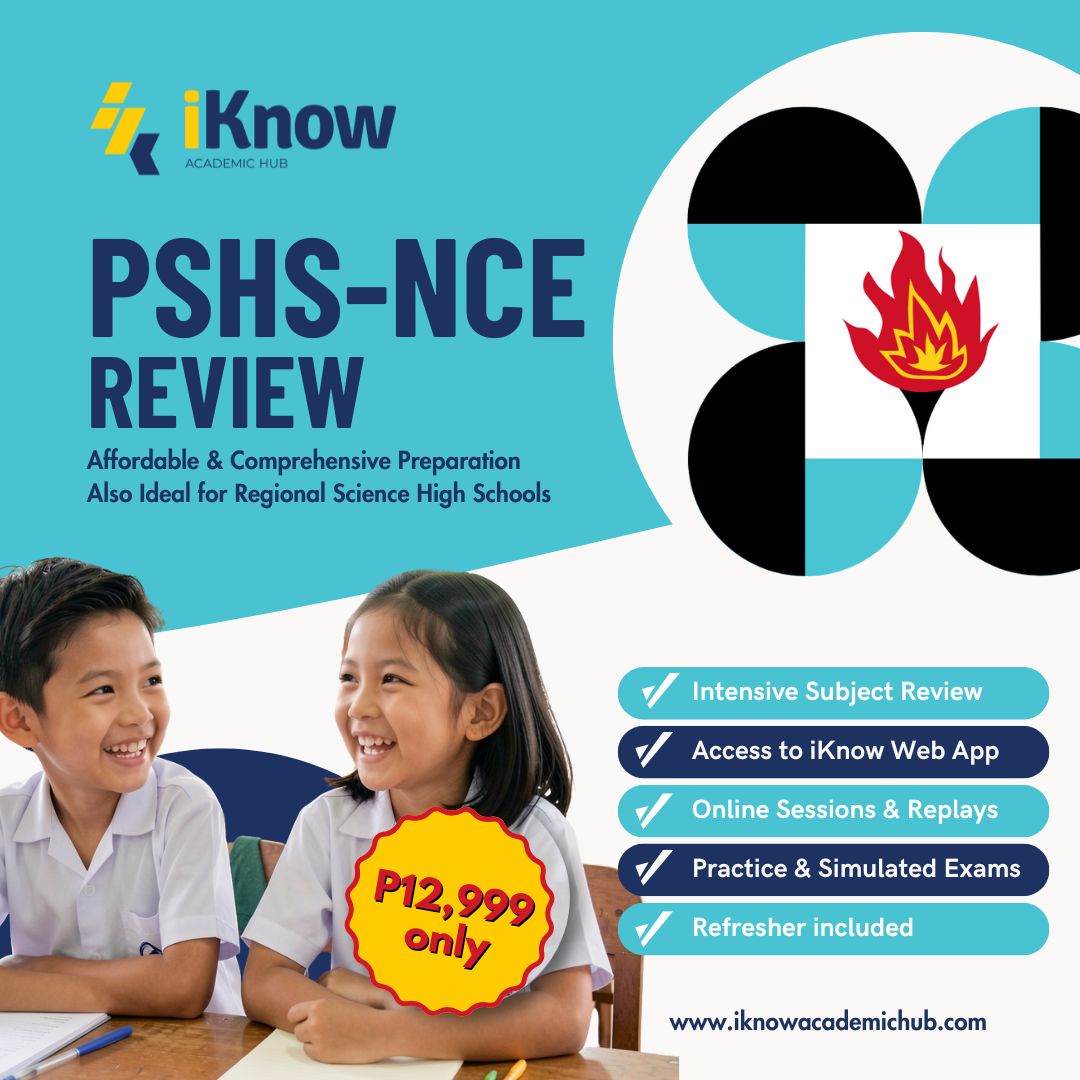
PSHS-NCE 2027 Review Program: Affordable and Comprehensive Preparation for Science High School Aspirants
Sun Feb 08 2026Preparing for the PSHS-NCE 2027 is a big milestone for Grade 6 students who aspire to enter the Philippine Science High School system. The exam is highly competitive and requires strong foundations in Science, Mathematics, and logical reasoning. With the right preparation, students can approach the PSHS-NCE 2027 with confidence and clarity. At iKnow Academic Hub, we offer a PSHS-NCE 2027 review program that is affordable, structured, and comprehensive, designed to guide students from early preparation up to final exam readiness. This program is also ideal for students applying to Regional Science High Schools, as the competencies and thinking skills tested are closely aligned. Why Enroll in Our PSHS-NCE 2027 Review Program Our PSHS-NCE 2027 review is built for long-term mastery, not cramming. We focus on helping students understand concepts, develop problem-solving skills, and build confidence over time. Affordable and comprehensive PSHS-NCE 2027 review for only ₱12,999 Step-by-step lessons in Science, Math, and logical reasoning Guided problem-solving and exam-style practice Consistent weekly sessions that support healthy study habits Strong preparation for both PSHS-NCE 2027 and Regional Science High School exams This approach allows students to improve steadily while avoiding burnout. PSHS-NCE 2027 Review Schedule and Program Details Our PSHS-NCE 2027 review runs over several months to give students enough time to absorb lessons and practice effectively. Regular Review Sessions Schedule: Fridays, 7:00 PM to 9:00 PM Duration: August 14 to December 18, 2026 Mode: Online, with guided discussions and problem-solving activities These sessions help students strengthen their fundamentals while learning how to approach challenging questions with confidence. Free Refresher Included for PSHS-NCE 2027 To ensure students are fully prepared before exam season, the PSHS-NCE 2027 review program includes a free refresher phase. Refresher Schedule Dates: January 8 to January 22, 2027 Days: Fridays and Saturdays Time: 7:00 PM to 9:00 PM The refresher focuses on key concepts, common question types, and test-taking strategies, giving students a strong final push before the PSHS-NCE 2027. Also Ideal for Regional Science High School Applicants Although this program is designed for PSHS-NCE 2027, it is also highly beneficial for students applying to Regional Science High Schools. The review strengthens analytical thinking, problem-solving skills, and core Science and Math concepts needed across science high school entrance exams. Parents can feel confident knowing their child is receiving structured and supportive preparation, while students benefit from clear guidance and encouragement throughout the review period. Register for the PSHS-NCE 2027 Review Program Slots are limited to maintain quality instruction and close mentor support. Early registration is encouraged. 👉 Register here:https://forms.gle/t3fYvUZY6csRNjdc8 At iKnow Academic Hub, we believe smarter preparation builds stronger futures. Enroll in our PSHS-NCE 2027 review program today and give your child the support they need to succeed in science high school entrance exams.
Read more
